


On Writing: What about writers’ groups?
mvtimes.com – Saturday October 10, 2026

It’s quite possible that “The Lord of the Rings” would never have been published were it not for the feedback J.R.R. Tolkien received in his writers’ group, the Inklings. In the 1930s and ’40s, Tolkien, along with C.S. Lewis and some 17 other writers, all men, met on Thursday evenings to discuss and dissect their work. They “were quick to praise one another; they were also highly critical,” according to Diana Pavlac Glyer, who wrote about the Inklings in her book “Bandersnatch.” Inklings member Robert Havard described their critiques as “frank but friendly,” and said, “Coming from a highly literate audience, it was often profuse and detailed.”
These days, with more books being published than ever before, writers’ groups like the Inklings have become so prevalent that it almost seems like finding and joining one is as much a part of the writing process as, say, procrastinating or doing some actual writing. There are writers’ groups to satisfy just about every literary itch, and niche — groups run by a facilitator and those that are freeform; genre-specific groups, and groups that throw every genre in the blender. There are highly structured writers’ groups, where each member gets a predetermined time for reading and feedback, and the loosey-goosey who’s-got-something-to-read-tonight approach; groups that give only positive feedback, or positive feedback first, and groups that emphasize critical feedback. Some writers’ groups are made up of just a few people; others will fill an auditorium. There are even nationally organized groups that have spawned regional chapters.
But are writers’ groups necessary? And do they work? I suppose the answer to those questions depends on who you are, how you like to write, and how well you receive feedback. For me, the answers are a definitive yes and yes.
To read the full article on mvtimes.com, click here
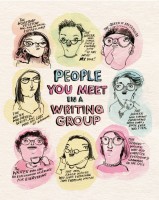 A deliciously cautionary tale about writing groups
 Sharing the writing experience... online
 9 Reasons Joining A Writing Group Is One Of The Best Ways A Writer Can Grow
 How to Read a Play as a Manual for Novel Writing
 Does the feedback in creative writing workshops make for better writing?
 Why Writing Stories For Children is So Much Harder Than Writing Stories For Adults
 The Writing Course Gold Rush
 What we learned about... non-fiction writing
 How Mindfulness Can Transform Your Writing Life
 Pete Kalu’s top tips for writing non-cliched multicultural characters
 What I learned from writing over 800,000 words in two years
 What Has Surprised You About The Writing Life? Intriguing Answers From Acclaimed Authors
 What Writing His First Novel Taught Author Ted Bell About Writing His Ninth Novel
 Writing books is not a sane way to make a living
 My Writing Education: A Time Line
 New Literary Agent Listing: Jenny Lewis
 New Publisher Listing: Fidelis Books
 UK publishers unite behind major campaign championing print
 New Literary Agency Listing: Blueprint Literary
 JK Rowling’s agent launches a new chapter for muted writers
 Brockhall author calls on local writers to get in touch after launching literary agency
 New Publisher Listing: KiN-TXT
 Maidstone LitFest 2026: Sian Williams, Helen McGinn, Adele Parks plus children’s authors Onjali Q. Raúf and Harriet Muncaster
 Publishing industry lays down AI rules to counter 'click-to-publish' books
 Obituary: Edite Kroll
 New Literary Agent Listing: Ellen Scott
 Quest is a highly designed sci-fi and fantasy magazine built for web fiction
 New Publisher Listing: Iron Stream